I have a minor Doom hoarding problem, console ports of the first two games specifically. This includes adjacent console ports like those for Wolfenstein 3D, Quake, Quake II, Heretic, and Hexen. Most of these don't compare all that well to the original PC versions. The quality range is wide and unexpected.
Of the Doom ports released in the 1990s, the consensus ranks the PlayStation port highest. The second place port is debatable, depending on what one thinks is most important. The first wave of console ports had to make compromises. Controls were changed, levels were dropped, enemies were removed, and the soundtrack altered. There are different opinions about which of these sacrifices led to better or worse versions.
The Jaguar, which runs the same CPU as the Sega Genesis, has one of the better Doom ports. It's superior to the 32X port which, of course, runs on the same CPU. I don't really know how to compare the rest of the hardware differences. The results are obvious though. Doom on the Atari Jaguar, even with the missing soundtrack, is about as good as a home port can get. The 32X port, on the other hand, feels more like a regular Genesis game. Zero Tolerance, which didn't require the add-on, isn't that far off from it.
I bought an Atari Jaguar on clearance because I happened to be holding the price gun when it was marked down to $49.99. It's not a terrible system for first-person shooters, using a broad definition of that term. Alien vs. Predator is the console's most iconic game. I might argue Tempest 2000 is better, but it's not an exclusive like Alien vs. Predator. The Jaguar version of Wolfenstein 3D is about perfect. Iron Soldier is probably classified as a "mech game" but is also technically a first-person shooter. I mean, it has a first-person perspective and you are shooting stuff. And then there's Doom. It has most of the original levels, and most of the original enemies. It looks very good, especially compared to other ports of the era. The Jaguar controller is a little awkward but the plethora of buttons is an advantage. The missing soundtrack is the consistent piece of negative feedback about it.
It was a long time, a very long time, before I learned that the Game Boy Advance version of Doom was based on the Atari Jaguar port.
I had to read multiple sources to confirm this because I didn't initially believe it. These are not comparable hardware platforms. The history of how this came to be seems complicated and drama-filled. I don't care about any of it. Sometimes I'm in the mood to dig into deep technical topics. Today is not one of those days.
When and where did I buy the Game Boy Advance version of Doom anyway? I have a whole section of this site dedicated to chronicling games I find in the wild. It's not there. I might have bought it on one of the 100s of trips to Toys 'R Us I took in the 2000s when my kids were young. A lot of my Game Boy Advance and GameCube collection came from checking out what was on sale there. It might have been an early eBay purchase. In the before times, when video games weren't ludicrously expensive there. That's probably the winner. It doesn't matter.
Somehow I never played the Game Boy Advance version of Doom. I always assumed it couldn't be any good. I'm going to prove myself wrong today.
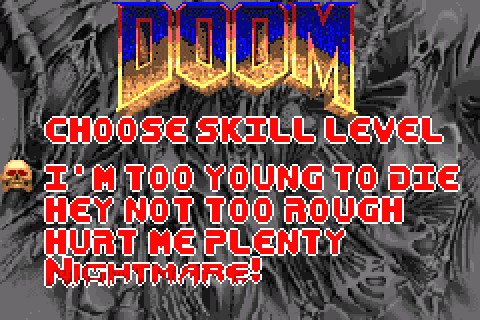
The title screen is promising. It's very bright and colorful. This is already better than I expected.
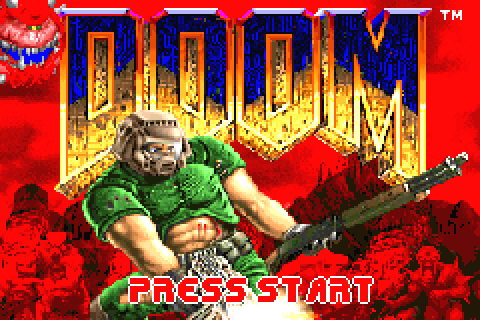
I'm going to play on the easiest setting. I am not ashamed by this. The nightmare setting is really ultra-violence by the way.
It's a little blocky, but it moves smoothy and doesn't look bad. A little blocky is acceptable. Since there is only a d-pad on the Game Boy Advance, it steers like the early console ports. It pretty much controls exactly the same as the Jaguar version. I'm not counting frames, but it looks better than the Super Nintendo and 32X versions in that department right away.
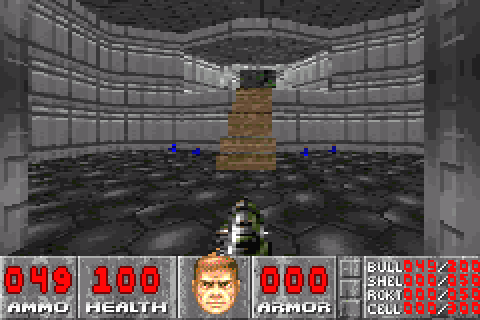
The mountains in the background are present and look better than I expected. The health packs still have the red cross which was made green in any Doom port you can buy today.
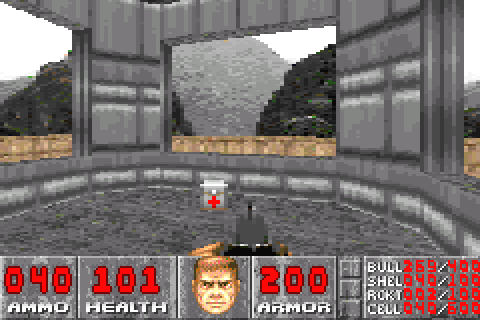
Speaking of green, the ammo boxes are now an extremely bright shade. This can't be due to a palette limitation, the Game Boy Advance could match the original color. I have to assume this was done to make the boxes easier to spot.
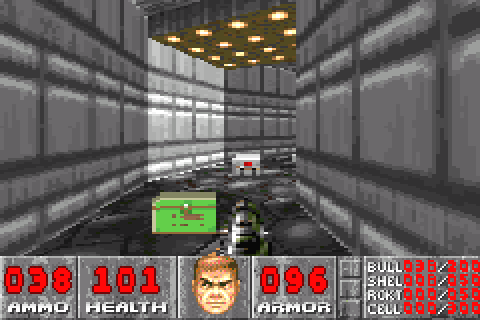
And staying on the topic of green a little longer... the mangled bodies are now green. This is the kind of thing people had come to expect on Nintendo systems though.
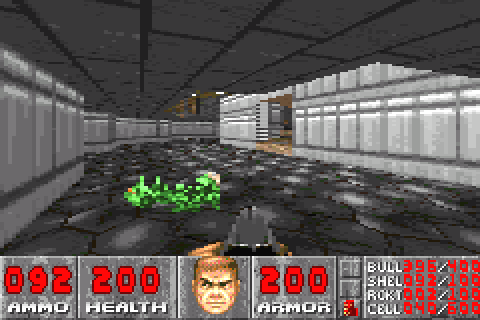
The Jaguar version had a keypad, making weapon changes simple. I could not figure out how to change weapons on the Game Boy Advance without reading the manual.
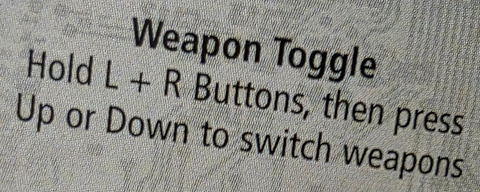
This is not a convenient sequence. However, with the large boss monsters removed I didn't change weapons all that much. I got through the entire game using the shotgun >90% of the time. OK, fine, I was also playing it on the easiest setting. There was never a time when I felt overwhelmed enough to break out the BFG until the very end.
I'm not going over this level-by-level. After a couple stages I accepted this was a very good port and decided to complete it. I went through about one stage a day over the course of a month. I didn't speedrun the levels nor 100% complete them.
Throughout my playthrough, I was impressed at how well the draw distance survived this conversion. Items and enemies might be pixelated, but they don't totally vanish.
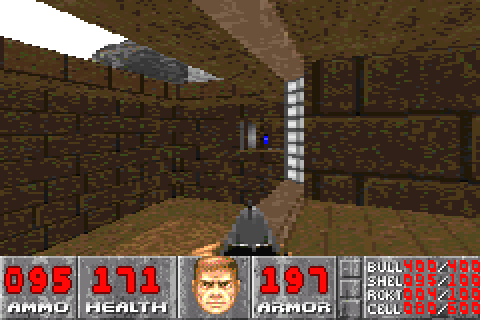
It's easy to tell what type of enemy is at the end of a corridor and dodge projectiles. Likewise, there is no degradation of firing distance for the player.
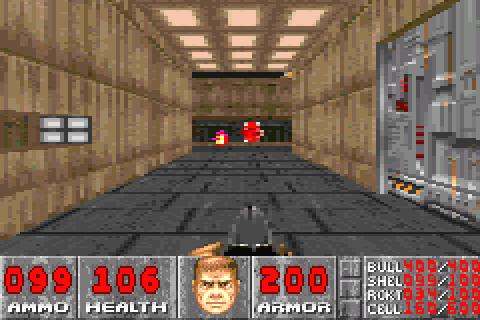
I don't think these pentagrams were intentionally replaced, they are simply pixelated. Although that is the kind of thing that one might expect censored on a Nintendo system. Was the Switch the first system where they eased-up on content restrictions?
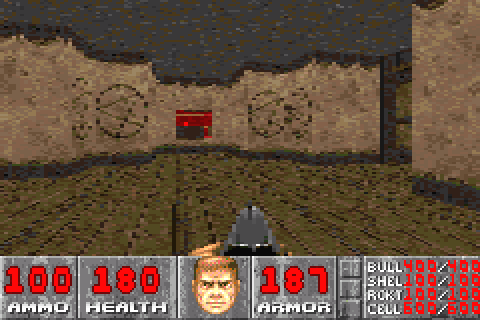
Here's an example of a location with a lot of stuff going on. There's lava, scenery, and an outdoor background. There's also no slowdown or any degradation at all.
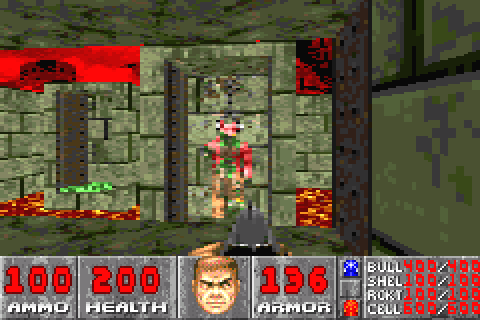
The hardest part of this version, for me, was fighting boss enemies in confined spaces. These barons are the strongest enemy in this version (cyber/spider demons are both absent). Switching weapons is, again, difficult. Worse though, it's not possible to switch weapons and move at the same time. So in other ports you can run around, dodging attacks, while swapping weapons. In this version, you need to find a place to camp for a second.
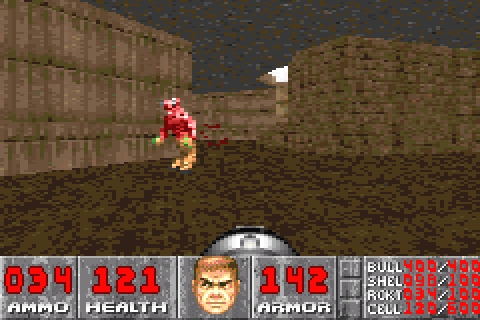
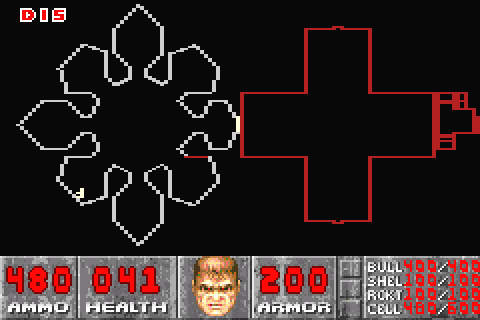
The last stage of this version is Dis.
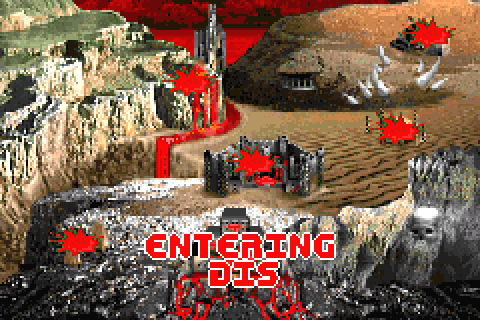
Although it is actually Fortress of Mystery. I don't know what to say. The Jaguar version is like this too. This is a hard level, even on easy mode, because of confined space again. You have to take damage to change weapons, there's no easy way around it.
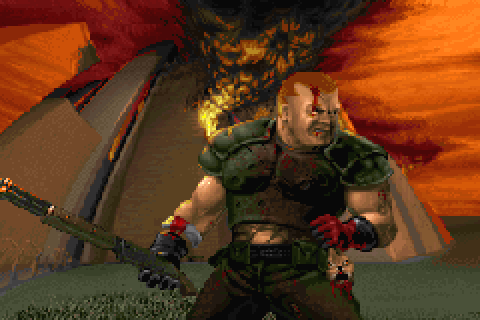
After that it has a real ending and everything.
I should have mentioned it sooner, but this version is not broken up into episodes. It's one continuous game. This makes the E2/3M1 stages much, much easier because you have all the previously collected weapons.
I'm not going to run on for too long here. The Game Boy Advance version of Doom is one of the better ports. I'd summarize it like:
Negatives: Kinda pixelated, missing two boss enemies, missing some stages, changing weapons is slow & may cause cramping.
Positives: Plays as well as one could hope, excellent draw distance, has music, good enough frame rate, still has over 20 stages, the cosmetic changes don't impact the gameplay at all.
I think the positives more than outweigh the negatives. I would rather play the Game Boy Advance version of Doom than several other ports. I'm not doing a port ranking but just off-hand... I'd put the Game Boy Advance version of Doom over the 32X, 3DO, Super Nintendo, and even Saturn versions.