It's time for me to finally understand my fascination with Super Pac-Man. As 1980s Pac-Man arcade games go, I'd rank them like:
I never played Professor Pac-Man. I saw it at Galloping Ghost but it was always occupied, even on a day that was otherwise not crowded. I'll assume it would go somewhere around 7 or 8 in this list.
This list ranks Super Pac-Man mid-tier among the early games, which still makes it one of the better games across the entire Pac-Man franchise (which I will not attempt to rank). Much later in life, I learned via watching a speedrun that every level can be trivially cleared with the same pattern. It's not a deep game. If I understood Pac & Pal better, I might rank it higher. An earlier version of me would rank Baby Pac-Man first, and that person is wrong.
Super Pac-Man is still something I play every chance I get. After some introspection, I think I can break down why:
In other words - irrational nostalgia.
The fact that no console ports of Super Pac-Man exist only makes it more interesting to me. There are ports for home computers you and I are barely aware of. Console ports, in the 1980s, didn't happen.
This is where 1983 is an important number to recall. Super Pac-Man should have had hasty Atari 2600 and 5200 ports that hit the shelves just in time for xmas 1983. Kids lucky enough to be kids in 1983 might remember receiving a new game console or piles of games as xmas gifts that year. That's because they were cheap. Over the summer, the home console market collapsed. A lot of us lucked out that holiday season because of it; we were all oblivious to the real situation. Super Pac-Man, like so many 1983 arcade games, didn't have a home port because the market wouldn't allow it.
If Super Pac-Man had a worldwide release in 1982, there's a very good chance an extremely rushed version would be on the Atari 2600 today. I know the existence of a Jr. Pac-Man Atari 2600 port conflicts with this theory a little bit. That is a weird outlier, though. One year is the difference between Super Pac-Man (and I suppose Jr. Pac-Man) having a decade of console ports vs. fading to relative obscurity.
"Dress for the job you want" someone said (there seems to be no direct attribution). I dress like a 1990s programmer because I haven't felt like updating my look since then. It's still the job I want, as unrealistic as that goal is. I wonder… if, in 1990, I was handed the job of porting Super Pac-Man to the Sega Genesis, how would I tackle it? I think I would first try to figure out how to recreate it on a single screen. Can it exist in its original form without scrolling?
Yes, of course I already know the answer to this question: no, because resolution. For a longer answer, I'll start by reviewing how other Pac-Man ports addressed this challenge.
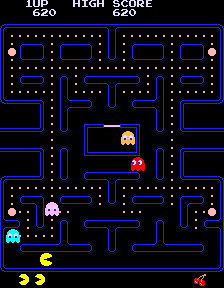
The original Pac-Man ran in a portrait perspective at 224x288 resolution. Sega Genesis games typically* run in 320x224 in landscape resolution. This is not taking overscan into account. One could develop a portrait mode Genesis game. It would be interesting... "Dear player, please flip your heavy-$#@ CRT on its side to continue"
The maze portion of Pac-Man is 224x248, 24 pixels (3 tiles), too much for the Genesis in a landscape perspective.
I'm not going to cover every Pac-Man game but will discuss two others. Ms. Pac-Man had a number of home ports; several of them had a scrolling maze. The original game runs in the same resolution as Pac-Man.
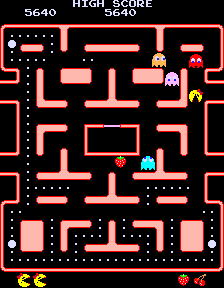
I'm going to look at some of the home versions to see what choices they made for both of these games. I'm going to skip some versions because they are not good recreations. That's step one of this idea: look at some different ways developers fit (or didn't fit) the maze within the resolution limits of home consoles.
I had to rule out the Atari 2600 and Intellivision versions of Pac-Man because the layouts are simply too different. That jumps us up to the Atari 5200 version:
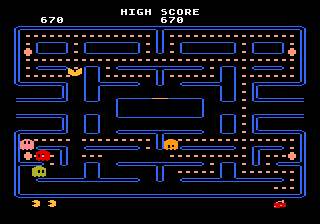
This version retains the original layout but compresses the height. The end result is a 292x172 maze, weird numbers but fine. The maze is shortened by 76 pixels. Here are some places where they made changes:
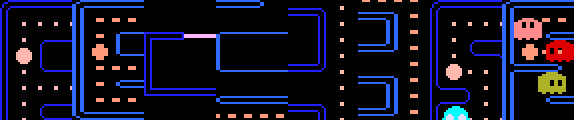
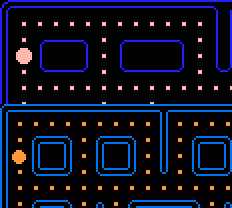
The NES version of Pac-Man is an excellent port of the original:
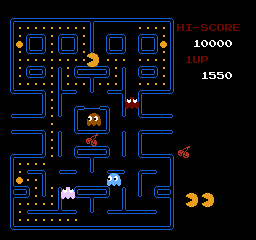
They went with a 164x212 maze. That is a ratio of 0.77, the arcade is 0.90, and the 5200 is 1.66. The NES version is not that far off. One comparison shows how the NES version is compressed roughly equally in both directions:
Let's switch over to Ms. Pac-Man, starting again with the Atari 5200:
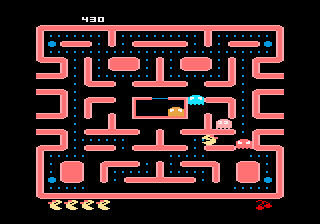
The developers again kept the same layout and shortened the height of the maze. The result is a 248x174 maze. It looks pancaked but it's good enough. They shaved a total of 54 pixels off the height. Here are some comparisons that show where they did a little trimming:
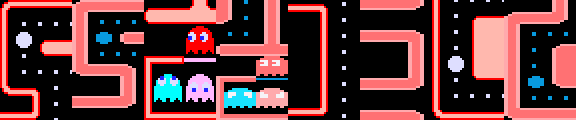
It's odd that the two Pac-Man games on the Atari 5200 have different maze sizes. Wider walls are the main culprit. There are other differences between these versions, but exploring those is not for this article.
Then there is this excellent version of Ms. Pac-Man on the Atari 7800:
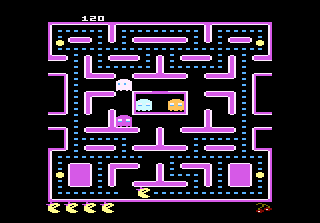
The maze here is 224x180, giving it a ratio closer to the Atari 5200. This is one version of Ms. Pac-Man I always go back to. It's not a perfect copy of the arcade original, or all that close to it, but it's fun. The Atari 7800 generally excels at arcade ports. Anyway, another quick comparison shows that they flattened the maze to fit on a single screen:
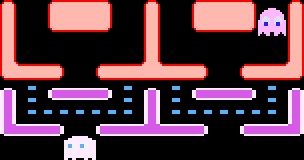
There are two versions of Ms. Pac-Man on the NES for reasons I don't care about. One port is by Namco, who made it a single screen game:
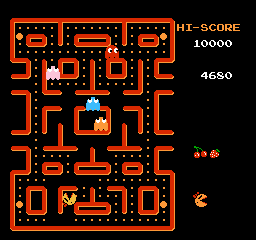
This maze is 165x213 which is a really strange number. It has a 0.77 ratio and makes similar adjustments to the NES version of Pac-Man.
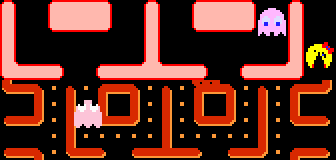
Meanwhile, the Tengen version of Ms. Pac-Man uses scrolling to achieve the original 224x248 maze size.
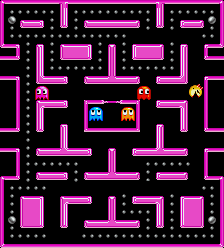
Whether this is better or worse is subjective. I don't enjoy getting ambushed by off-screen ghosts, so I prefer the versions with altered maze sizes.
Other Tengen versions of Ms. Pac-Man have the full-size maze with scrolling. They also include some mini mazes that almost fit on one screen.
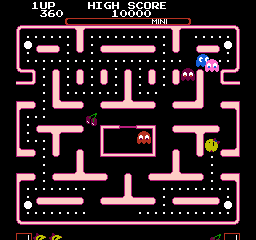
The maze fits on a single screen but there is still scrolling because the score and extra lives fall off.
Now for the topic that I planned this article to be about: is there any way to port Super Pac-Man to the Sega Genesis without scrolling?
Note: I am not going to actually port Super Pac-Man to anything, because I don't enjoy legal takedown letters. I reserve the right to create a game inspired by it, or something else involving a single-screen maze.
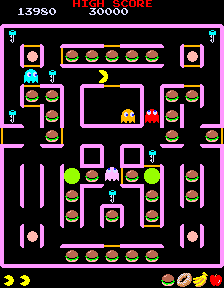
This will of course not fit as-is. The maze in Super Pac-Man is 224x244. It's 20 pixels too tall. Let's think about options...
One option is scaling while attempting to preserve the same layout and ratio. This makes 200×216 (25X27 8x8 cells) about the only practical choice. I think. Let's start with an empty maze at 224x244:
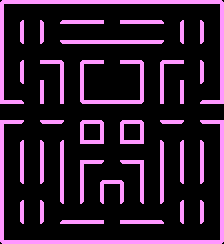
We need to trim off 24 and 28 pixels, while ensuring the passages can still fit 16x16 sprites. Right away, this looks difficult. The Pac-Man and Ms. Pac-Man ports trimmed unused space. The entire Super Pac-Man board is used. There aren't empty maze blocks that can be crunched down like the other two games.
Taking 16 pixels off the sides in the top half is easy enough:
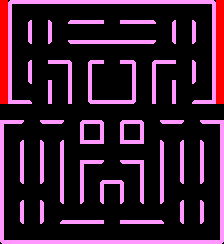
There's less to work with on the bottom half. I don't think anything can be done without changing the layout.
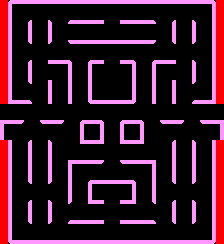
This is not the worst thing ever. Although it is now a different game. That lower enclosed box is probably going to be cut completely by the time I'm done. It's annoying anyway.
What can we do with the middle section?
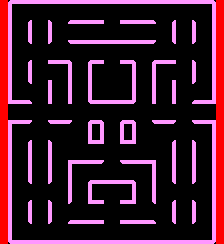
Then one adjustment is needed to ensure all the corridors are 16 wide/tall:
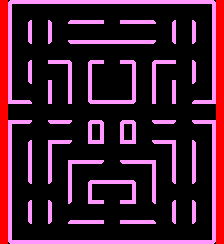
This is 8 pixels less than I planned to trim. I might leave it this way though. I'm OK with the ratio being a little off. The width has more flexibility than the height. 28 pixels have to go. Here's my initial idea:
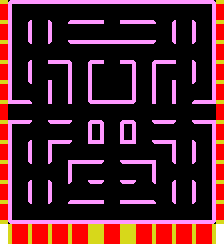
This gets us a maze of 208x224. This fits but risks running into overscan. On an emulator, this will look OK. What I didn't catch at first, and I should have, is how the maze is alternating between 4-pixel walls and 16-pixel corridors.
Recognizing that pattern - the section that is 48 wide (16+16+16) could be cut down to 44 (4+16+4+16+4). Around here:
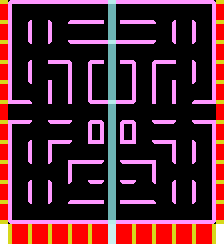
That gets to 204, but 208 isn't possible (or is difficult) if that pattern is to be followed. Even at 204, we kind of have to deviate from the pattern a little.
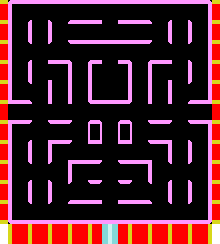
This is not so bad. The layout is more different than I wanted, but it's overall fine.
Another option, which I don't like, is simply scaling it by exactly 1/2.
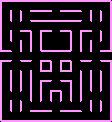
The layout is exactly the same, but it would be hard to see. This would fit on a Game Boy screen with plenty of room to spare.
180x196 is a nearly identical ratio which is a little easier to see. Rounding to 3 places, it is identical. How would that work?
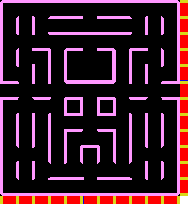
Not bad at all. Instead of alternating between 4 and 16, it (mostly) alternates between 3 and 13 (with one extra line both horizontally and vertically). It fills most of the height available. I should have started with this idea.
If I'm going to abandon the idea of the maze dimensions being multiples of 8, then I should go all-in and make the final maze 179x195:
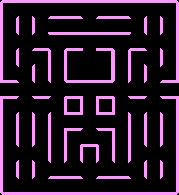
The sprites and objects would still be 16x16 in terms of tiles. They would appear 13x13; I hope that makes sense. The larger Sega Genesis color palette can help hide the downsizing a little. I'm not much of an artist, but here are how some conversions could look:

There will be wasted space because tile reuse is non-existent once we move to a non-8x8 maze. This entire hypothetical port would fit on a standard Sega Genesis cartridge with tons of room to spare.
There's still the issue of how to place (draw) items into this maze. Tiles have to be drawn at locations that are multiples of 8 because that's how it works. It might actually be easiest to make all the objects sprites because then they can be set to specific (x,y) coordinates. They can then be moved off-screen when consumed. Super Pac-Man does not come close to hitting the 80 sprite limit and only gets a little close to the 20 sprites per scanline limit.
What I've figured out so far is that 1) Super Pac-Man could be ported to the Sega Genesis without scrolling. 2) This port could definitely include other maze variations like a ½ scale version, or alternate single-screen layouts like the Tengen Ms. Pac-Man port, or even a scrolling mode if anybody wants that.
Now what about interlace mode? Interlace mode 2 to be specific. I am not an expert or even a novice on this subject. Normally, graphics on the Sega Genesis are sets of 8x8 tiles. In interlace mode 2 they are 8x16, which means the system is outputting 320x448 instead of 320x224. It's the same number of cells though. The result is that squished look that most have only seen in Sonic the Hedgehog 2.
There are some reasons I don't think this is a panacea:
I will concede that interlace mode 2 may work. I also think it fits under "more hassle than it is worth". It wouldn't be practical to make it an option alongside the other maze variations discussed. Switching to interlace mode 2 means VPD blank events fire at different intervals. So there are some game logic changes that have to be considered based on which video mode the player selected. If you have the budget and skill of the Sonic 2 team that's fine, this hypothetical project wouldn't have either.
Figuring out the maze is the most difficult part of this project. If you already have code to read controllers, move sprites, and basic game state management then the rest of this port isn't a ton of heavy lifting. Even these maze conversion ideas weren't that tough to think through.
Alright, so this was another fun thought exercise that produced nothing tangible. Maybe next time I will actually finish something.
Tags: Arcade Atari NES Sega Genesis Game development